
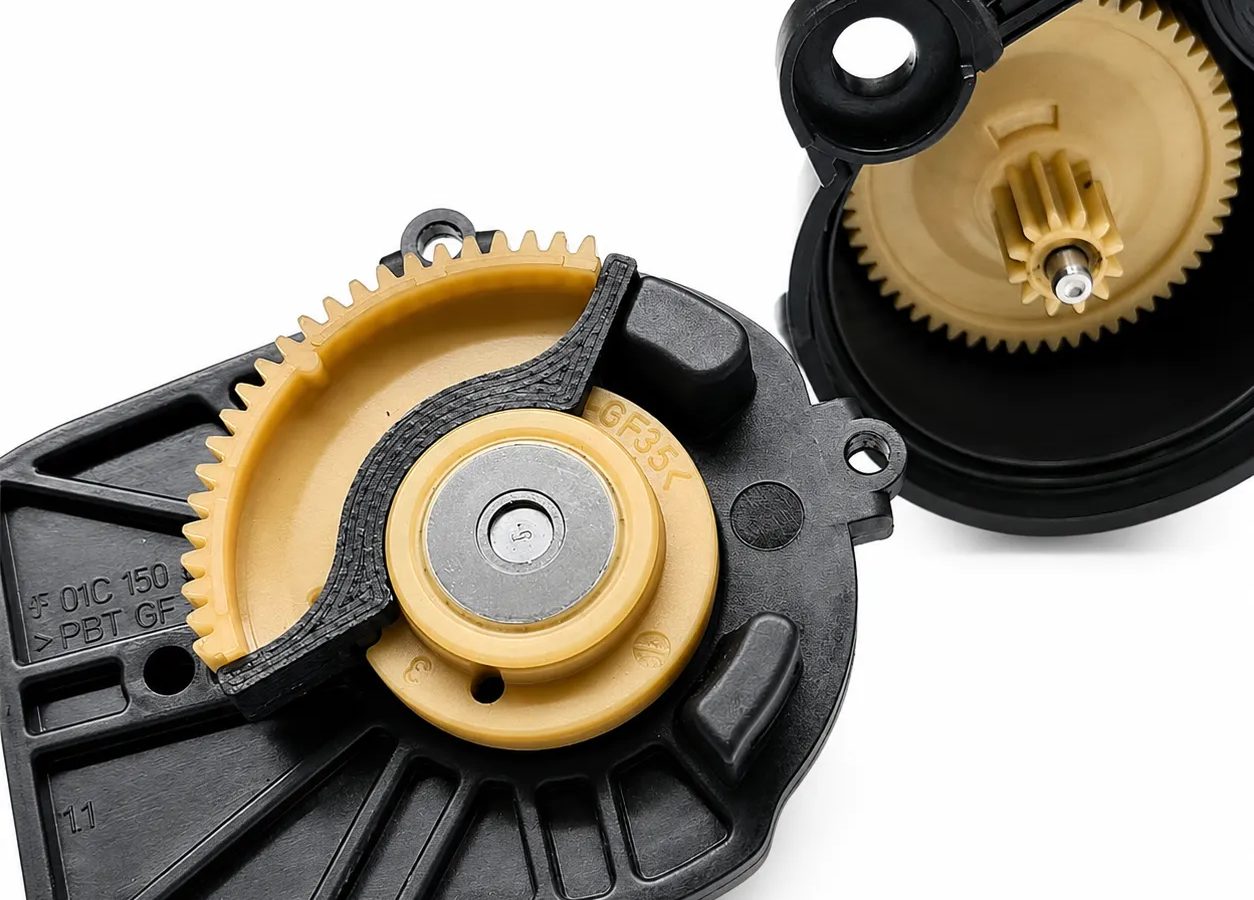
BMW 2C3200: Do You Really Need a New Intake Manifold?
A recurring swirl-flap fault does not automatically mean a new manifold. Here is what to check, when an actuator insert can help, and what it will not fix.
You clear the fault, the BMW drives normally for a while, and then 2C3200 comes back. The scanner mentions a broken lever, but the linkage looks intact. Does that mean you need a new intake manifold?
Not necessarily. BMW fault code 2C3200 points to a problem with the swirl-flap mechanism or its movement. It does not, by itself, prove that the electric actuator or the whole manifold needs replacing. The useful next step is to find out what moves, what does not, and whether the actuator is reaching its intended stops.
This guide explains where the FIXHEN N1044 swirl-flap actuator repair kit can help—and the faults it will not fix.
What does BMW fault code 2C3200 mean?
Depending on the diagnostic tool, you may see wording such as “swirl flap actuator mechanically faulty,” “lever broken,” or “swirl flap plausibility: mechanically defective.” The common thread is that the diesel engine control unit is not seeing the movement it expects from the swirl-flap system.
“Lever broken” is a diagnostic description, not a photograph of the failed part. A worn connection, excessive travel or a mechanism that binds can require a closer inspection even when nothing has visibly snapped. Owners also report the code alongside electrical faults, so read the complete fault list rather than stopping at the first line.
One small but important distinction: 2C3200 is a fault code, not an OEM part number. You cannot use it alone to identify your manifold or order a matching actuator.
What are swirl flaps, and why does their movement matter?
Swirl flaps are movable parts in the intake manifold that change how air enters the engine. An actuator operates the mechanism, and the engine management monitors its position or movement. If the motor turns but a worn connection no longer transfers that movement properly, the system can still register a fault.
That is why “the actuator moves” and “the system works” are not the same thing. You need to look at the actuator, the linkage and the flap mechanism together.
What should you check before buying a manifold?
Start with diagnosis, not a shopping list. A workshop familiar with BMW diesel intake systems should be able to check the following against the procedure for your engine:
- Record all fault codes. Note whether 2C3200 is present on its own or accompanied by position-sensor, supply-voltage or other electrical faults.
- Inspect the connector and wiring. This is especially worth checking if the problem started immediately after intake or engine work.
- Inspect the mechanical connections. Look for a detached link, damaged lever, free play or wear at the travel stops.
- Check the flap mechanism for resistance. Carbon contamination or physical damage may prevent normal movement. Do not force a mechanism that is binding.
- Compare commanded movement with actual movement. A suitable diagnostic tool can help establish whether the problem is electrical, mechanical or related to the learned travel range.
If an electrical fault is also present, investigate it. A mechanical insert cannot repair a damaged wire, restore a missing electrical supply or replace a failed position sensor.
Where does the N1044 repair kit fit into this?
N1044 is a two-piece PA6-GF kit for the original swirl-flap actuator. It is not a replacement intake manifold, a complete electric actuator or a set of manifold blanking plugs.
The design uses a click-in insert inside a compatible actuator to control its travel at the intended stops. The published design information describes it as a solution for broken, loose or worn swirl-flap lever arrangements, including certain setups where the flaps have already been removed.
It is worth considering when inspection confirms that this mechanical arrangement is the source of the fault and the actuator itself is otherwise serviceable. It is not a sensible substitute for diagnosing a seized mechanism or an electrical failure.
The FIXHEN product is supplied in PA6-GF—glass-filled nylon 6. Compare the product photographs and kit details with your actuator before ordering.
Will it fit my N47, N57, B47 or B57?
The kit is listed for compatible actuator arrangements on BMW N47, N57, B47 and B57 diesel engines. Treat that as a starting point, not a guarantee that every version uses the same parts.
Confirm your engine code and compare the actuator construction with the product images and installation reference. A BMW badge, model name or registration year is not enough. The same model range can contain different engines and intake assemblies.
If you are unsure, have your workshop identify the actuator before buying. A clear photograph of the opened mechanism is more useful for comparison than a fault-code screenshot alone.
Do you need to remove the swirl flaps to use it?
The design is described for both repair applications and compatible arrangements where the swirl flaps have already been deleted. That does not mean removal is required, or that the kit restores every function of the original intake system.
Repairing actuator travel and removing intake flaps are different jobs. The insert is not a blanking kit and does not seal openings left by removed components.
For a road car, discuss retaining and repairing the original system with your workshop first. Changes to the intake system may affect emissions compliance or inspection requirements; check the rules where the vehicle is used. Do not assume that clearing a fault makes a modification compliant.
Does fitting it need coding or an adaptation reset?
Do not confuse coding, clearing a fault and teaching the actuator its travel limits. They are different operations.
The design author describes applications without software modifications. However, owner discussions also report questions about adaptation and low-speed performance after changing the mechanism. That is not enough evidence to promise that every car will need—or will not need—a reset.
Follow the diagnostic procedure for your particular engine and actuator. If an adaptation or end-stop learning procedure is required, use a tool that supports it. Simply deleting the code is not proof that the repair is complete.
Why does 2C3200 return after you clear it?
Clearing the fault removes the stored report; it does not remove wear, free a binding flap or repair an electrical connection. If the underlying problem remains, the control unit can detect it again.
If the code returns after a repair, recheck the physical installation, actuator travel and the complete fault list. Do not keep clearing it and assume the car just needs more driving. Owners have reported apparently intact linkages with recurring faults, which is exactly why movement and feedback need checking.
Can you keep driving with a swirl-flap fault?
The code alone cannot establish that your car is safe to drive. The answer depends on the actual failure and the symptoms.
If there are loose or broken intake components, unusual mechanical noises or a significant loss of power, stop using the car and arrange an inspection. A warning that disappears after a restart does not confirm that the mechanism is sound. Do not leave damaged parts in the intake and rely on an actuator insert to deal with them.
What should happen after installation?
Use the short installation reference to understand where the insert sits, not as a replacement for the workshop procedure. Work on a cool engine and keep dirt or loose pieces out of the intake.
Once the compatible insert is securely fitted, the workshop should check movement, carry out any required learning procedure, clear the stored faults and scan again after an appropriate functional check. Confirm that the original symptoms have gone as well as checking the fault memory.
The bottom line: do not condemn an entire manifold from 2C3200 alone. If diagnosis identifies the compatible actuator's worn lever or stop arrangement as the problem, N1044 offers a targeted repair option. If the fault is elsewhere, fix that fault first.
Sources and further reading
The product specification supplies the FIXHEN kit material and contents. The design listing explains the insert's intended use; the owner discussions below illustrate recurring diagnostic questions, not controlled tests or guarantees.
More from Guides
 Guides
MINI Cooper heater not working on one side? Here's the usual cause
Warm air on one side of your MINI, cold on the other? On F55, F56, F57 and F54 it's usually the mixing flap. How to check it and fix it without a new heater box.
 Guides
Nissan Cabstar / Maxity heater blowing cold? Check the flap actuator gear
Heater stuck on cold or hot in your Nissan Cabstar or Maxity? It's often a cracked plastic gear on the flap actuator. Here's how to tell and how to fix it cheaply.
 Guides
BMW Electric Tow Hitch Not Working? Motor Runs but Arm Won't Move – Gear Fix (71606795730)
Motor whirs but the BMW electric folding tow bar won't swing out? Stripped gears are a common cause. Symptoms, diagnosis, part numbers and fitting tips for E60, E61, X3, X4, F10, F11, G30 and G31.